
Gentle Touch · The Journal
The science of slow scratching
Eighty minutes, $120, and 40 of those minutes are somebody scratching your back. The nerve fibres that answer to it only fire inside a narrow band of speed, which is most of the reason the session is built the way it is.
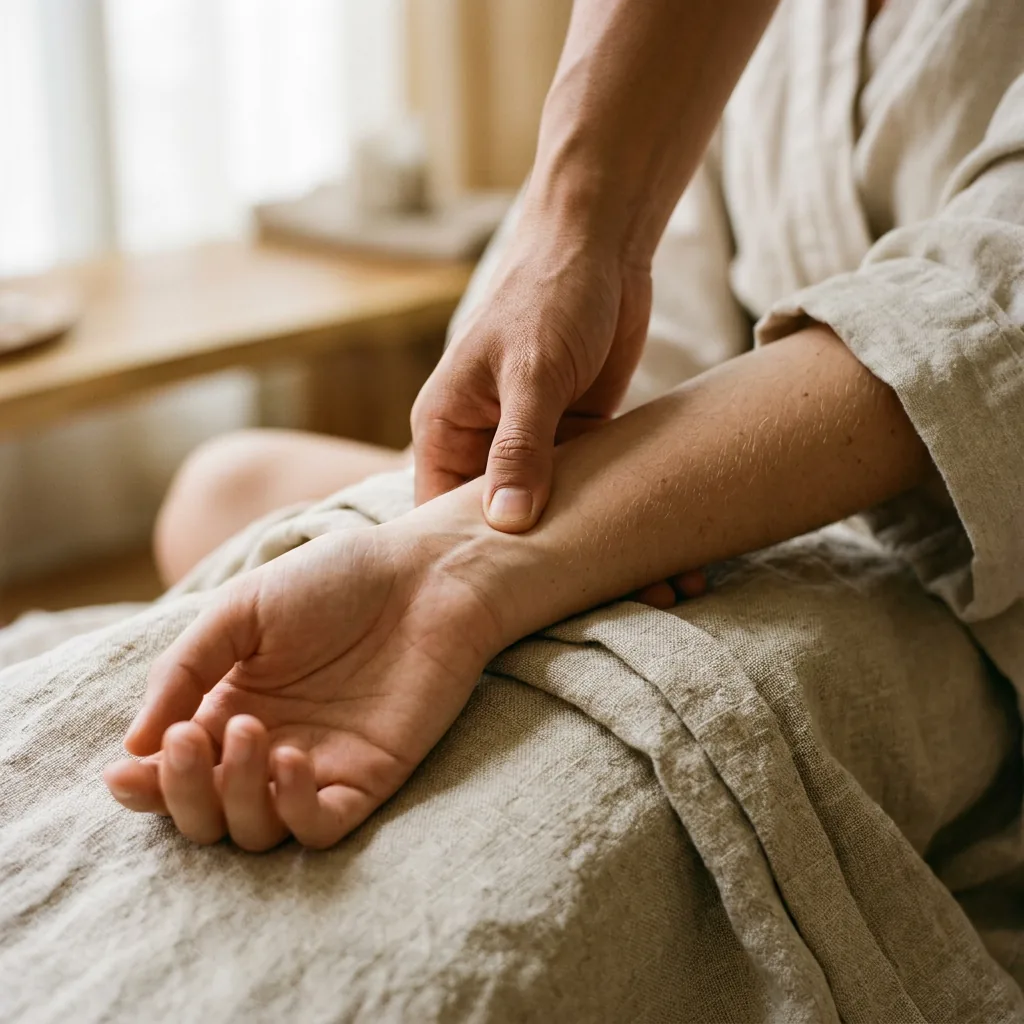
Forty of the eighty minutes are somebody scratching your back, slowly, and that's the half people book the session for. Underneath the skin there's a class of nerve fibre that mostly ignores pressure and fires hardest at a hand traveling about three centimetres a second — roughly the speed you'd use on someone else without ever thinking about it. Eighty minutes runs $120 at our place on W Central Ave in west Wichita.
What is a scratching massage?
Eighty minutes in two equal halves. Forty minutes of essential-oil massage on the back, then forty minutes of slow scratching — back first, then out across the shoulders and down the arms, then the scalp. One line item on our menu, $120, no shorter version. The practical side of booking it, from what to wear to when the late starts run out, is on the scratching massage page.
Why does slow scratching feel different from fast scratching?
Because the fibres that respond to it are tuned to a speed, and fast scratching sails straight past them.
The fibres that only answer to slow
Researchers call them C-tactile afferents. They're thin, unmyelinated and slow-conducting, and they run separately from the quick, well-insulated fibres that tell you a wasp has landed on your forearm. Stroke skin at under a centimetre a second and they barely bother. Push past ten and the response falls away again. In between — roughly 1 to 10 centimetres a second — they fire, and the strongest response sits at about 3 centimetres a second.
Three centimetres is a little over an inch. It's also, near enough, the pace a person uses when they stroke somebody else's arm with no instructions: a parent's hand down a child's back, a hand left on a shoulder. Nobody teaches that speed and nobody counts it out. The therapist doing your second forty minutes isn't working off a metronome either — scratching pace lands inside that window without anyone aiming at it.
Why nobody scratches your feet
C-tactile afferents turn up in hairy skin. They haven't been found in the glabrous skin of the palms and the soles, which is the dense, high-resolution stuff built for grip and fine discrimination. So the second half of the session runs back, arms, scalp, and stops there. That's not squeamishness about feet — there's nothing in the sole for slow stroking to talk to, which is why a foot massage at $50 for the hour is built on firm thumb pressure instead, and produces a completely different sixty minutes.
Why isn’t the whole eighty minutes scratching?
Because skin quietly gives up on anything that never changes. Rest a still hand on someone's back and within a minute they've largely stopped noticing it's there. Slow scratching gets around that by moving and by shifting where it lands, but forty minutes is about the outside edge of the trick — much past that and people start hearing the room again.
The first forty are doing something else entirely. Warm oil, broad strokes down either side of the spine, then firmer work into whatever's seized up across the shoulder blades. Come in after ten hours overhead on a wing panel and that half is the one earning its keep; the scratching afterwards lands on a back that's already warm rather than one still braced.
What forty minutes of travel adds up to
At three centimetres a second, forty minutes works out at roughly 236 feet of hand moving across your back, arms and scalp. That figure is an order-of-magnitude sketch, not a measurement. It's useful for one comparison only: the version you get at home ends when the other person's arm gets tired, which is usually inside a minute.
Is a scratching massage the same as ASMR?
No, and a fair number of guests arrive having found the one through the other.
ASMR — autonomous sensory meridian response — is a name coined online in 2010 for a tingling sensation some people get at the scalp and down the neck. The common triggers are quiet sound, slow deliberate hand movement and close personal attention, and there are millions of videos built on them. Plenty of people feel nothing at all watching one. The ingredient list is shared — slow, unhurried, close, repetitive — except that in a treatment room it's happening on your own skin instead of through a pair of headphones.
A scratching massage is ASMR with a table.
ASMR names a response, reported mostly to sound and video. This is 40 minutes of physical contact, and the touch is what the slow-touch fibres in your skin are tuned for. A lot of people who like one like the other, and plenty of guests booked this after a year of the videos.
What do people say afterwards?
Calm, heavy and unusually sleepy — and a fair share say nothing at all for the first few minutes. Those are guest reports, and they're worth keeping in a separate column from evidence.
What the research bodies will put their names to is broader. The National Center for Complementary and Integrative Health lists massage among the mind and body practices studied for stress and relaxation, and says the risk of harmful effects from massage therapy appears to be low. Mayo Clinic describes relaxation techniques as a way to lower stress and ease tense muscles. Neither of those names scratching in particular. The slow-touch fibres are the piece with a research literature behind them, and the session is built around what they respond to.
Who ends up booking it
Two groups, mostly. People who've decided they're bad at massage — they lie down, and then spend the hour drafting tomorrow's emails. Firm pressure gives that sort of mind a job to do, whereas slow scratching hands it nothing to hold onto, and for a few people that turns out to be the difference between lying on a table and going somewhere else for an hour.
The other group came in for a normal hour, read the menu while they waited, and booked this one out of curiosity. Some of them never book anything else. If you'd rather start with the ordinary version, the body massage is $60 for sixty minutes and you can always come back for the long one.
Is it safe?
For most healthy people, yes — there's no deep pressure and no joint work anywhere in the second half, which makes it one of the gentler things on our menu. The precautions that matter here are about skin rather than muscle.
Booking the eighty minutes in west Wichita
$120, one length, at 10646 W Central Ave #106, Wichita, KS 67212 — north side of Central, just west of N Maize Rd, in the strip by Chili's and the Walmart Neighborhood Market, across from the Dillons. Hours are Sun–Thu 9:30 AM – 9 PM · Fri–Sat 9:30 AM – 9:30 PM, seven days, no closed day.
Aromatherapy is the upgrade that suits this booking best at $10, since scented oil runs through the whole session rather than plain oil for the first half. It isn't bookable on its own — ask when you arrive or add it in the booking flow. Book online, or call (316) 347-6999 before you drive over and ask what's open. Eighty minutes is a long block to find free, and it has to finish before we lock up.