
Pressure · The Journal
Deep tissue vs Swedish: how to pick
Swedish is long, even strokes over all of you. Deep tissue is slower work on less of you. Both are the same booking at the same price here, so the choosing happens out loud, in the first minute of the hour.
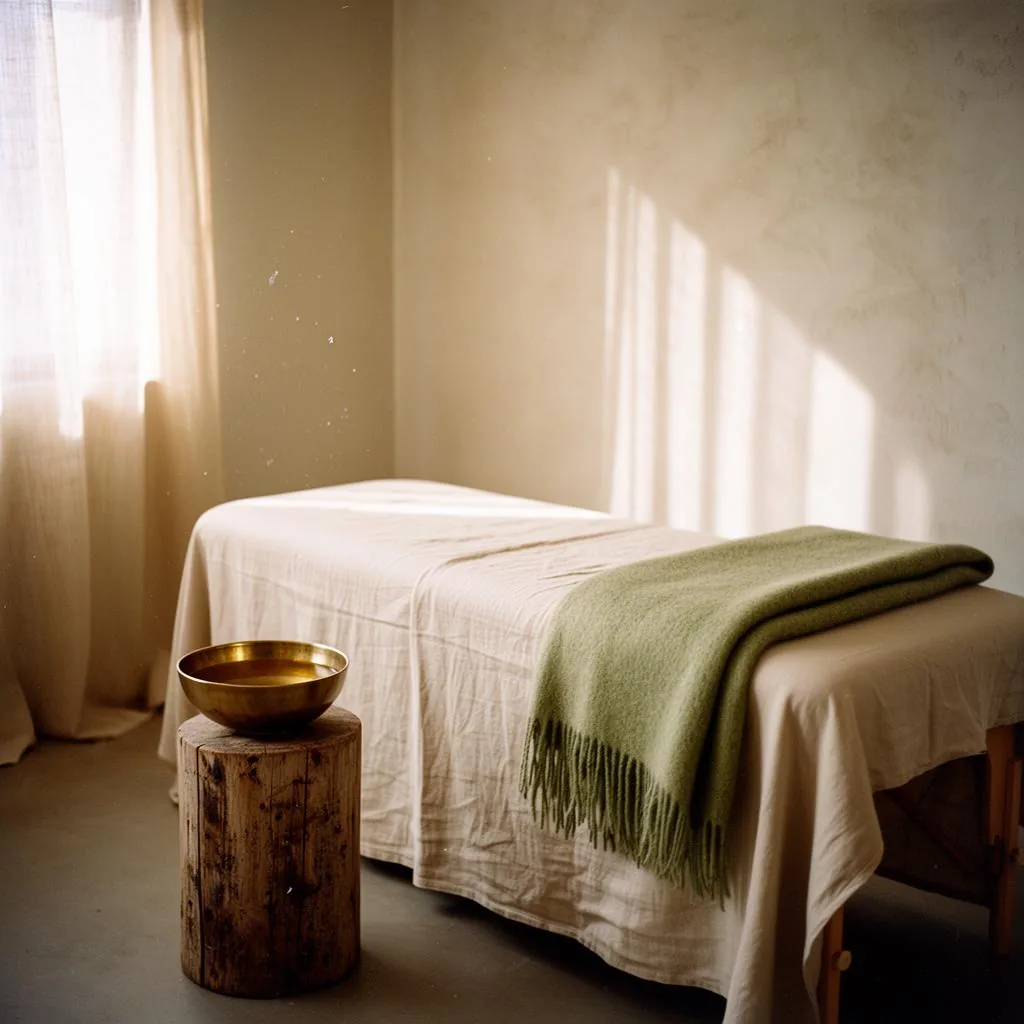
Both are $60 for the hour here. You pick between them in a sentence at the start of the session rather than on the booking screen, and you can change your mind at minute twenty. Swedish means long, even strokes over the whole body at a lighter pressure. Deep tissue means slower, firmer work on a few areas you name.
What’s the difference between deep tissue and Swedish massage?
Pressure, and how much ground gets covered in the same hour. A Swedish hour keeps moving — back, shoulders, arms, legs, feet, neck — in long continuous strokes with plenty of oil and a rhythm steady enough to fall asleep to. A deep tissue hour stops. The therapist finds the tight band under your shoulder blade, stays on it, works across the fibres slowly, waits for it to give, then moves to the next one.
The arithmetic is the part people skip past. Sixty minutes is sixty minutes either way, so time spent properly on one shoulder is time not spent on your calves. Ask for deep pressure everywhere in an hour and the therapist has roughly seven minutes a region, which isn’t long enough to do the slow work anywhere.
What a Swedish hour feels like
Warm, continuous and fairly predictable. The strokes run the length of a limb rather than across a muscle, the pace stays even, and there’s very little that makes you open your eyes. Mayo Clinic groups massage with the relaxation techniques it recommends for lowering stress and easing tense muscles, which is a fair description of what this hour is doing. It’s also the right first massage for somebody who has never had one.
What a deep tissue hour feels like
Slower, and punctuated. Forearm and elbow more than fingertips, less glide because the therapist needs grip on the tissue rather than speed over it, and pauses where they hold pressure and wait. You’ll be asked how it feels more than once. That isn’t politeness — there isn’t a gauge on a shoulder, so your answer is the only reading anyone gets.
| Swedish | Deep tissue | |
|---|---|---|
| Pressure | Light to moderate | Firm, adjusted as you speak |
| Rhythm | Continuous long strokes | Slow, with pauses on one spot |
| Covered in 60 minutes | Back, shoulders, arms, legs, feet, neck | Two or three regions, properly |
| Oil | More of it — the work glides | Less glide, more grip on the tissue |
| You would ask for it by saying | “I want to switch off for an hour” | “This spot has been bad for a month” |
| Price here | $60 / 60 min, $90 / 90 min | $60 / 60 min, $90 / 90 min |
- Swedish
- Light to moderate
- Deep tissue
- Firm, adjusted as you speak
- Swedish
- Continuous long strokes
- Deep tissue
- Slow, with pauses on one spot
- Swedish
- Back, shoulders, arms, legs, feet, neck
- Deep tissue
- Two or three regions, properly
- Swedish
- More of it — the work glides
- Deep tissue
- Less glide, more grip on the tissue
- Swedish
- “I want to switch off for an hour”
- Deep tissue
- “This spot has been bad for a month”
- Swedish
- $60 / 60 min, $90 / 90 min
- Deep tissue
- $60 / 60 min, $90 / 90 min
Is deep tissue more expensive in Wichita?
Often, yes. Several studios in town price the pressure as well as the length. Beau Monde West Spa lists the hour three ways — $120 relaxing, $125 firm, $130 deep tissue — and the gap widens at ninety minutes, $160 against $175. SunJoy Massage Spa, a mile east of us on Tyler, publishes $60 for a classic hour and $70 for deep tissue. Under Pressure on W Maple builds its whole menu around deep tissue at $85 for sixty minutes, by appointment only.
Ours is $60 for sixty minutes and $90 for ninety, whichever pressure you ask for, because there’s one Body Massage on the menu and the pressure is a conversation inside it. The whole price list sits on the body massage page. Competitor figures above were read in September 2026 off each studio’s own page or booking platform, and published prices move.
Does the research pick a winner?
It doesn’t separate the two at all. The National Center for Complementary and Integrative Health lists massage among the approaches that may improve pain and function in chronic low-back pain — and it says that about massage therapy, under one heading, as one body of evidence. Named styles barely appear. What one studio calls deep tissue, another calls therapeutic and a third calls firm; that vocabulary grew up inside the trade, and nobody has run the two names against each other in a way that would settle which is better.
So the choice is a preference, and a preference is a perfectly good reason to book one over the other. If firm pressure on a bad shoulder is what leaves you moving better on Tuesday morning, ask for that. If an hour of even, quiet strokes is what finally gets you to sleep on a Sunday night, ask for that instead, and nobody at the front desk will read anything into it.
Deep tissue is the therapeutic one. Swedish is just pampering.
Same room, same therapist, same $60. NCCIH lists massage among the approaches that may improve pain and function in chronic low-back pain, and it makes that statement about massage therapy generally rather than about the trade names studios print on a menu.
How do I ask for what I want without using either word?
Name the places, name the pressure, and say what you want to be able to do tomorrow. A therapist can work from that in a way they can’t work from a style name, because neither style name tells them which side of your neck hurts.
-
Start with the map
“Left shoulder blade, the right side of my neck, lower back on the same side.” Two or three named places beat any label on a menu. If it is genuinely everywhere, say that too — it points straight at the even, whole-body version. -
Then the pressure, in your own words
“As firm as you can go without me tensing up.” “Nothing that makes me hold my breath.” “Really lean on the shoulders, then go light everywhere else.” All three are clearer than either trade name, and the third is the most common request we get. -
Say what to leave alone
A shoulder you've had surgery on, a fresh bruise, ticklish feet, a scar you'd rather nobody touched. Thirty seconds of this changes the whole hour, and nobody will ask why. -
Say something at minute ten
Ten minutes in, you know whether the pressure is right. That's the moment to change it — not at the end, and not afterwards in your head on the drive back down Central.
How firm is too firm?
The moment you start bracing. Deep work can ache while it’s happening, in a way that feels like something being worked loose, and plenty of people like that ache. What it shouldn’t do is make you hold your breath, grip the edge of the table or lift a shoulder away from the therapist’s hand. When you tense against pressure the muscle pushes back, and the hour stops doing anything useful.
So which should you pick?
Answer the question one level down. Most people who walk in undecided already know how they want to feel walking back out, and that settles it faster than comparing definitions.
Swedish, if
- you haven’t been sleeping, or you’d like to;
- nothing hurts in particular and everything feels wound up;
- it’s your first massage of any kind;
- you’re sensitive to pressure, or the thought of somebody leaning into your back right now sounds like more, not less.
Deep tissue, if
- one or two named places have been bad for more than a week;
- your day holds you in one shape — ten hours overhead on a wing panel, eight in a truck seat, a shift spent leaning over a chair or a keyboard;
- lighter pressure has felt like it wasn’t reaching anything;
- you want the hour spent on your shoulders and don’t much care whether anyone touches your calves.
Or ask for both, in one booking
This is what most regulars end up doing: firm and slow on the back and shoulders for the first half, then long even strokes over everything else to finish. At sixty minutes that’s a trade-off. At ninety, for $90, it stops being one, and the session-length guide puts the four lengths side by side. Himalayan salt stone adds $20 if you want heat with either half, and the customized session page covers how the split usually runs.
Is either one risky?
The NCCIH’s own summary is that the risk of harmful effects from massage therapy appears to be low, and its chronic pain review adds that physical approaches including massage therapy are generally safe for healthy people when performed appropriately, while people with medical conditions and people who are pregnant may need to modify or avoid some of them. That applies to firm pressure as much as to light.
Tell us before your session if you’re pregnant, taking blood thinners or living with a clotting disorder, if you’ve had a clot, if there’s a fracture, open wound, burn or skin infection anywhere we’d be working, if you’re running a fever, or if you’re in active cancer treatment. Some of those change what we do; some mean we’ll ask you to check with your doctor first. We don’t diagnose anything and we don’t treat conditions.
Pain that’s new, severe or getting worse week on week belongs in front of a doctor first. Book the massage as well if you want one — the two sit alongside each other perfectly happily. Just don’t let one postpone the other, which is the NCCIH’s standing advice as well as ours.
Booking either one
We’re at 10646 W Central Ave #106, north side of W Central just west of N Maize Rd, open Sunday to Thursday 9:30 AM to 9 PM and Friday and Saturday until 9:30 PM. Book online, walk in, or call (316) 347-6999 before you drive over and ask what’s open. You book the body massage either way, and the pressure is the first thing we’ll ask you about.