Cupping · The Journal
Cupping marks, explained
They are suction bruises, and most of them fade in three to seven days. What the NCCIH says about the risks, why the circles matter at a doctor’s appointment, and what the $20 add-on gets you on W Central Ave.
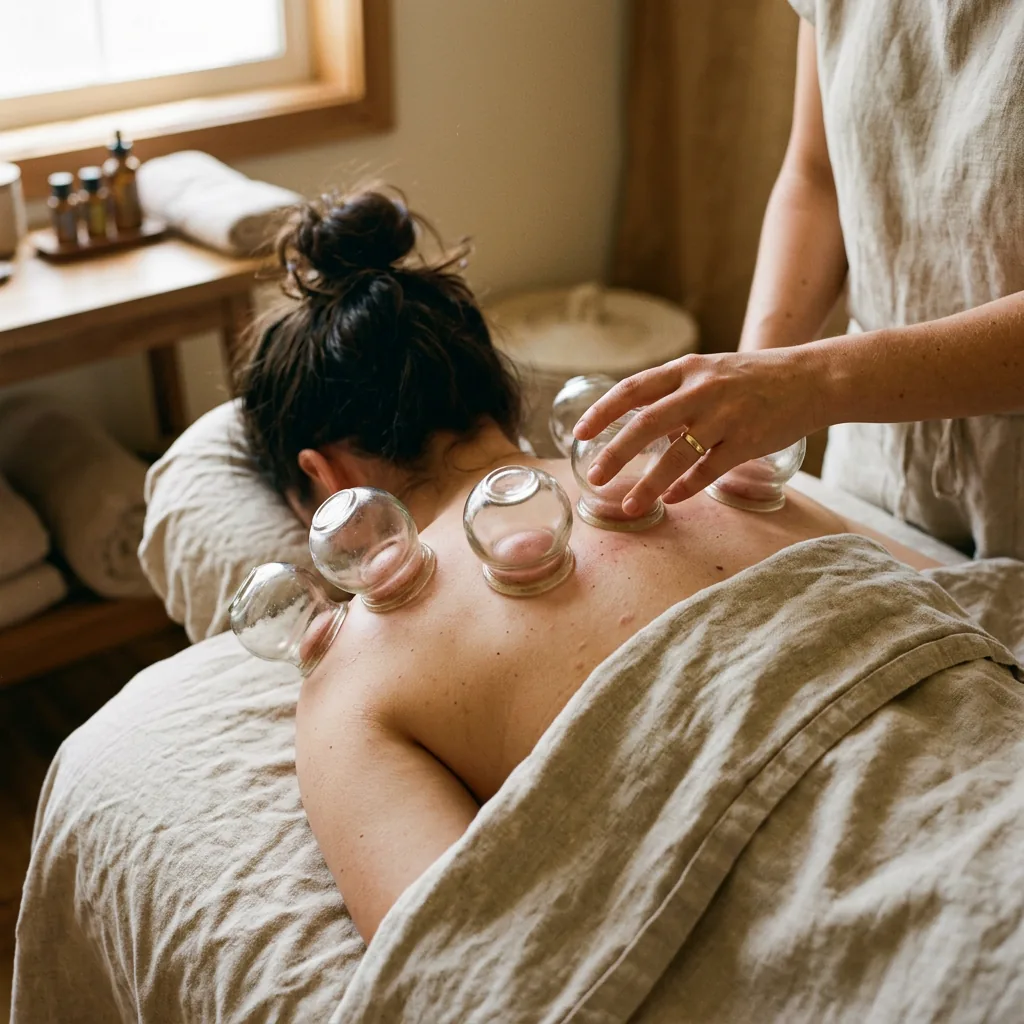
Cupping marks are bruises made by suction, and for most people they fade in three to seven days. Nothing is being drawn out of you. A cup sits on the skin, the air under it is pulled out, the tissue lifts into the vacuum, and a few small vessels near the surface let go — which is what a bruise is, whatever caused it. The circle is just the shape of the rim. Cupping at Diamond Massage is a $20 add-on to a session you’ve already booked.
How long do cupping marks last?
Three to seven days is the ordinary range. A short, light pull on a shoulder can be gone by the next morning. A firm one held across a locked upper back can still be faintly visible at day ten. They fade through the same sequence as any other bruise — dusky red or purple at first, then browner, then a yellow ring that thins out to nothing.
What changes how long they stick around
Three things, mostly. How much suction was used, how long each cup sat, and how easily you bruise in the first place. That last one varies more between people than the first two vary between sessions — some people go a faint pink and are clear in 48 hours, others mark deeply from a pull they barely felt. If you take blood thinners or live with a clotting disorder you will mark more, and darker, so tell us at the desk before we start rather than after.
If you’ve got a wedding, a photo or a swim meet this month
Count backwards. Two weeks of clearance is comfortable; three days is a gamble, and it’s the upper back and shoulders — the area cupping is most often used on — that a dress or a swimsuit shows. If the timing is tight, say so when you arrive and we’ll leave the cups off and put the whole session into hands-on work on the same area. Nothing about the massage depends on them.
Why does cupping leave round marks?
Suction, and only suction. There is no scraping and no friction on the skin. The vacuum lifts the tissue under the cup, capillaries close to the surface release a small amount of blood into the surrounding tissue, and that pooled blood is what you can see for the next few days. Because the rim of the cup is round, the mark is round.
Cupping pulls toxins out of the body.
The marks are blood drawn toward the surface, not anything leaving it — the skin is never broken in the version of cupping used as a massage add-on. The NCCIH page on cupping makes no toxin claim of any kind. What it does say is that “cupping may help reduce pain, but the evidence for this isn’t very strong.”
What does the research say about cupping?
That it may help with pain, and that the studies behind it are small. The National Center for Complementary and Integrative Health, part of the National Institutes of Health, states it in one sentence:
Cupping may help reduce pain, but the evidence for this isn’t very strong.
So book it for what it is. Cupping is a different sensation from pressure — a sustained pull instead of a push — and people who add it tend to be the ones whose upper back or shoulders haven’t budged under thumbs alone. It sits inside traditional Chinese medicine, the same tradition our foot work comes from. On the massage itself the same agency is more definite: the risk of harmful effects from massage therapy appears to be low.
The one thing to tell your doctor
That the round marks are cupping. Say it before anyone has to ask, because a row of dark circles across a back is not obvious to a clinician who wasn’t expecting them. The NCCIH is unusually direct about this:
Cupping leaves temporary marks on the skin. The origin of these marks should be explained to health care providers so that they won’t be mistaken for signs of physical abuse.
In practice that means the pre-op appointment at Ascension Via Christi St. Teresa, four and a half miles northwest of us. The sports physical before a season starts. A blood draw, a dermatology visit, a physio session, or a massage the following week with a therapist who has never seen you before — that last one matters for a working reason as well as a social one, since nobody should be putting deep pressure through a fresh mark. One sentence at the start of the appointment handles all of it.
Is cupping safe?
For most healthy people, yes, and NCCIH names the exceptions rather than leaving them vague. Their cupping page lists the side effects as “persistent skin discoloration, scars, burns, and infections,” and adds that cupping “may worsen eczema or psoriasis.” Two of those are the ones we screen for at the desk, and one of them is the reason the next section exists.
The cups, and the standard we’re inspected against
Infection is on that NCCIH list for a real reason: equipment that touches one person’s skin and then another’s, without being cleaned in between, is a route for skin and bloodborne disease. Wichita doesn’t leave that to good intentions. City code § 3.55.150 requires every surface subject to skin contact to be cleaned and disinfected after every use, with an EPA-registered product effective against MRSA and VRE. That is the written standard a Wichita massage business is held to, and you are allowed to ask what we use.
Kansas has no state massage license. The City of Wichita licenses at city level instead — Chapter 3.55 requires a business license and a therapist permit for every therapist, both renewed every two years, and every working therapist carries a city photo ID card. Ask to see it any time. Our guide to what to check in Wichita walks through the whole chapter.
How much is cupping in Wichita, and how do I add it?
$20 on top of whatever session you book. Cupping in Wichita mostly turns up inside physical therapy and chiropractic practices, where it comes priced into a treatment plan; here you tick it in the booking flow alongside the salt stones and the aromatherapy. It isn’t bookable on its own, and we don’t publish a duration for it, because it’s worked into a massage rather than run as a separate appointment.
What it comes to on each session
The arithmetic is short. Sixty minutes of body massage is $60, so $80 with cupping. Ninety is $90, so $110. The combo hour at $60 comes to $80. The whole add-ons shelf is printed on the services page next to everything else. If your back is the reason you’re reading this, the back tension page covers what the session itself looks like.
Where we are, and how to ask for it
We’re at 10646 W Central Ave #106, Wichita, KS 67212 — north side of W Central Ave, just west of N Maize Rd, in the strip by Chili’s and the Walmart Neighborhood Market, across Central from the Dillons. Open Sunday to Thursday 9:30 AM to 9 PM, Friday and Saturday until 9:30 PM. You can book online and tick cupping in the flow, or walk in and ask. If you want it today, call (316) 347-6999 before you drive over and ask what’s open.